PostgreSQL vs MongoDB: Choosing the Right Database for Modern Applications

Abdelatif Baha
Paris, FRANCE
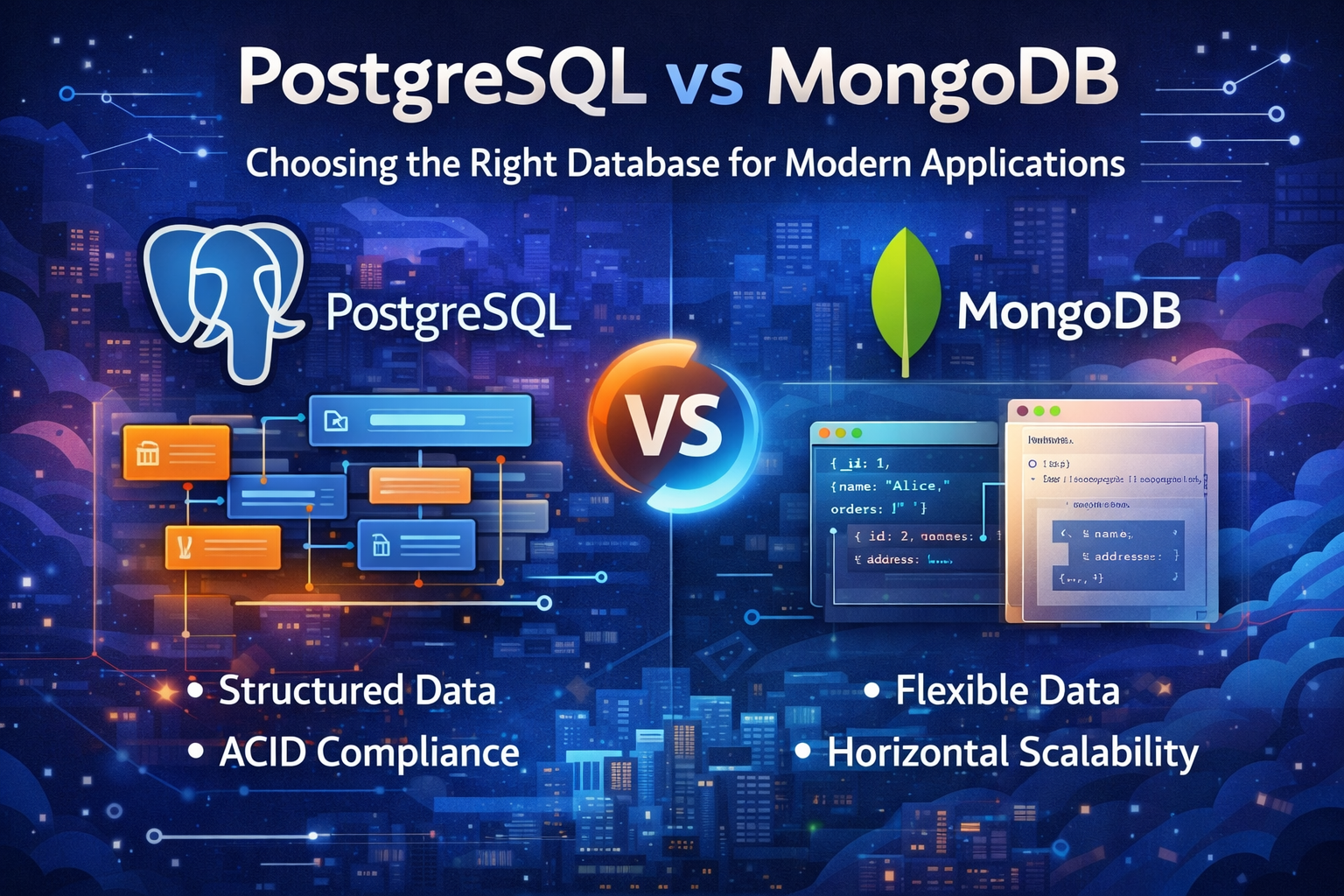
Choosing a database is never just a technical checkbox, it is a structural decision that shapes performance, scalability, and long-term maintainability. PostgreSQL and MongoDB are two popular choices with very different philosophies. One comes from a long tradition of relational databases, the other embraces a document-oriented, schema-flexible model. Understanding their differences helps you pick the right tool for the job instead of forcing one to behave like the other.
Data Model and Structure
PostgreSQL is a relational database. Data is stored in tables with predefined schemas, and relationships between tables are expressed explicitly using foreign keys. This structure enforces consistency and makes complex relationships easy to reason about.
MongoDB is a document-oriented database. Data is stored as JSON-like documents (BSON), which can vary in structure even within the same collection. This flexibility allows you to model data closer to how it is used in the application, especially when dealing with nested or evolving data structures.
Schema and Validation
PostgreSQL is schema-first. You define your tables and constraints upfront, which ensures strong data integrity. This approach reduces ambiguity and catches errors early, at the cost of requiring migrations when your data model evolves.
MongoDB is schema-flexible by default. You can insert documents without enforcing a strict structure, which speeds up prototyping and iteration. Schema validation can be added, but it is optional and often lighter than what relational databases enforce.
Querying Capabilities
PostgreSQL uses SQL, a mature and expressive query language. It excels at complex queries involving joins, aggregations, subqueries, and window functions. This makes it particularly strong for analytical workloads and data-heavy business logic.
MongoDB uses a document-based query language designed around JSON structures. Queries feel natural when working with nested data, but complex joins are more limited and handled through aggregation pipelines, which can become harder to reason about at scale.
Transactions and Consistency
PostgreSQL has full ACID compliance by default. Transactions are reliable, predictable, and well-understood, making it a solid choice for financial systems, ERP software, or any application where data correctness is critical.
MongoDB supports ACID transactions as well, but historically it focused more on eventual consistency and performance. While modern versions handle multi-document transactions, they are generally used more selectively due to performance considerations.
Performance and Scalability
PostgreSQL scales very well vertically and supports horizontal scaling through replication and extensions. It performs exceptionally for read-heavy and complex query workloads, especially when properly indexed.
MongoDB was designed with horizontal scalability in mind. Sharding is a core feature, making it easier to distribute data across multiple nodes. This makes MongoDB attractive for very large datasets and high-throughput workloads where flexibility and scale are priorities.
Typical Use Cases
PostgreSQL shines in applications that require strong consistency, complex querying, and structured data. Examples include SaaS platforms, financial systems, analytics dashboards, and applications with rich relational models.
MongoDB is often a good fit for content management systems, real-time applications, event-driven architectures, and projects where the data model changes frequently or contains deeply nested structures.
Conclusion
PostgreSQL and MongoDB are not competitors in the sense of one being strictly better than the other. They solve different problems with different assumptions. PostgreSQL offers structure, reliability, and powerful querying rooted in decades of relational database theory. MongoDB offers flexibility, scalability, and a data model that aligns closely with modern application code.
The right choice depends less on trends and more on your data, your constraints, and your long-term goals. Pick the database that works with your problem, not against it.
Comments (2)