Why Next.js Offers More Than Plain React for Production Applications

Abdelatif Baha
Paris, FRANCE
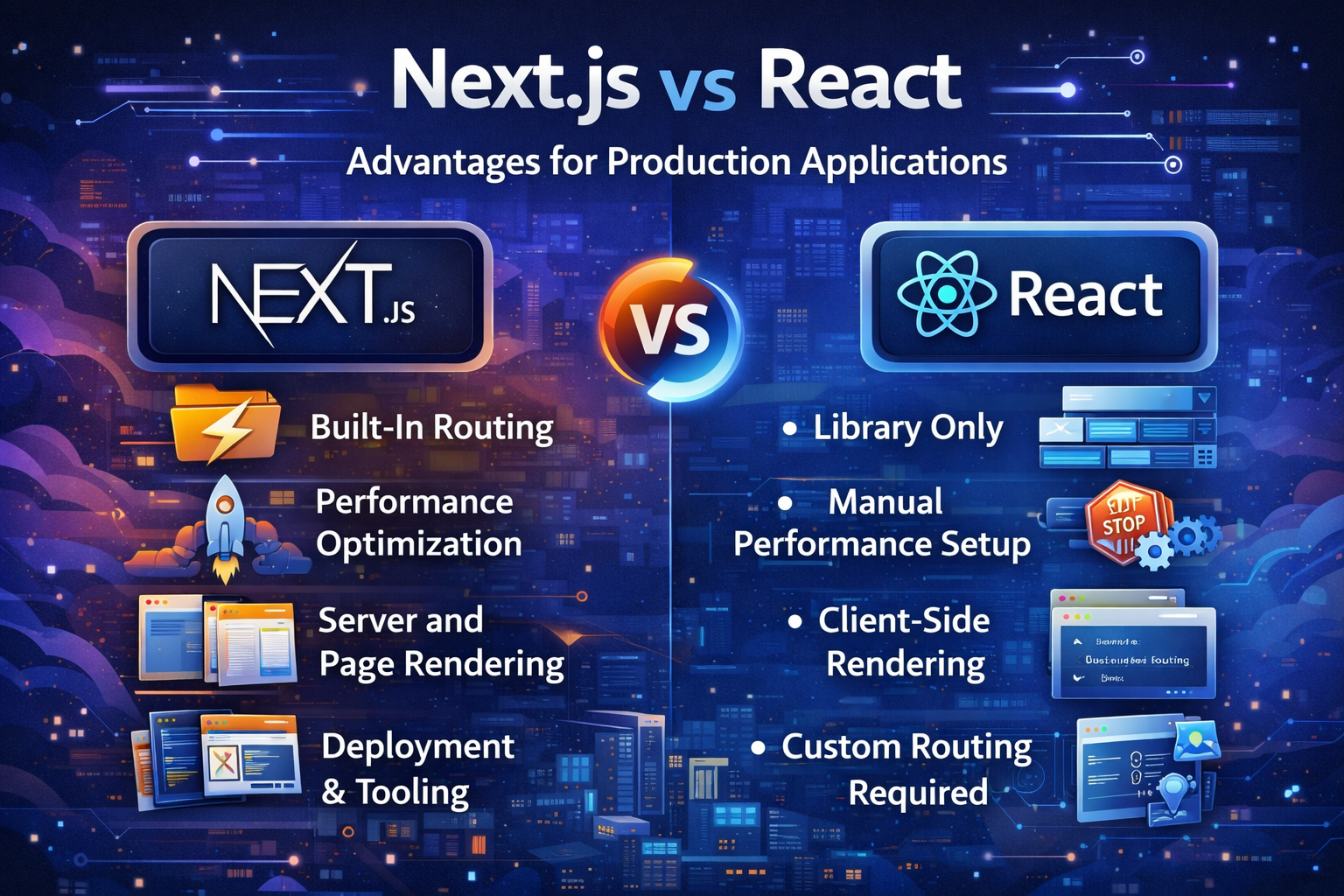
React is a powerful library for building user interfaces, but by design it focuses on a single concern: rendering UI components. Next.js builds on top of React and turns it into a full-fledged framework, addressing many of the practical challenges developers face when moving from prototypes to production-ready applications.
From Library to Framework
React provides flexibility, but that flexibility comes with decisions to make. Routing, data fetching, bundling, code splitting, SEO, and deployment are not opinions baked into React itself. Each project often ends up with its own stack of tools and conventions.
Next.js takes a more opinionated approach. It provides a complete framework with sensible defaults, reducing decision fatigue and making projects more consistent across teams and environments.
Built-In Routing and Layouts
With React alone, routing requires an external library and manual configuration. While this offers freedom, it also adds setup complexity and room for inconsistency.
Next.js includes file-based routing out of the box. Pages and layouts are defined directly by the project structure, making navigation intuitive and predictable. Nested layouts and shared UI elements are easier to manage and reason about as the application grows.
Rendering Strategies Out of the Box
React focuses primarily on client-side rendering. While this works well for many applications, it can lead to slower initial loads and weaker SEO if not handled carefully.
Next.js supports multiple rendering strategies natively, including server-side rendering, static site generation, incremental static regeneration, and client-side rendering. This allows developers to choose the best approach per page or feature, balancing performance, freshness, and scalability.
Performance as a Default
In a React-only setup, performance optimizations often require additional tools and manual effort. Code splitting, image optimization, and font loading need to be configured explicitly.
Next.js includes these optimizations by default. Automatic code splitting ensures users only load what they need. The built-in image and font handling systems optimize assets automatically, leading to faster load times without extra configuration.
Data Fetching and Server Logic
With React, data fetching is typically handled entirely on the client or through custom server setups. This can blur responsibilities and complicate architecture.
Next.js introduces a clear separation between server and client logic. Server components, API routes, and server-side data fetching allow sensitive logic to stay on the server while keeping the client bundle lean. This leads to better performance and improved security.
Comments (8)